Ohio Governor Mike DeWine issued a Stay at Home today due to COVID-19. Order goes into effect Monday at 11:59 pm.
DeWine said there will be a few exceptions, which are listed in the above link to the state’s Coronavirus website.
A Publication of Ohio Statehouse News LLC

Ohio Governor Mike DeWine issued a Stay at Home today due to COVID-19. Order goes into effect Monday at 11:59 pm.
DeWine said there will be a few exceptions, which are listed in the above link to the state’s Coronavirus website.
Energy and Policy Institute: Clean Energy oversight group or political operatives?
Who Watches the Self-Proclaimed Watchdogs? What Exactly is the Energy and Policy Institute?
Throughout the debate over Ohio House Bill 6, Ohio news media and clean energy groups frequently cited the work of an innocuous sounding organization called the Energy and Policy Institute. As recently as March 5, 2026 Dave Anderson, the policy and communications manager for the Institute, was the primary source of research for an article on FirstEnergy contributions to organizations supporting the bill.
“Powerful corporations, and utilities in particular, often fund groups to do their dirty work in an attempt to avoid accountability,” Anderson said. But research into the Energy and Policy Institute have borne out their own abject hypocrisy.
In fact, a well-sourced report from the nonprofit Campaign for Accountability reveals that the Energy and Policy Institute (EPI) is just as secretive as the organizations it exposes. EPI is a dark money group: it does not appear to have nonprofit status, it is not registered with any relevant secretary of state, and no one admits to funding it. It appears that EPI may be simply the creation of a public relations firm. Nevertheless, journalists treat EPI as they would any other watchdog organization. 1
According to the Facebook Page for EPI, they were founded in October 2013. But the trail gets murkier from there. Neither their Facebook Page nor their website lists a physical address nor a telephone number. The only address reported is a Post Office Box for San Francisco.
Furthermore, the organization does not appear to be registered as either a nonprofit or for-profit company with any relevant state secretary of state. As part of their research into EPI, the nonprofit Campaign for Accountability searched corporation databases in California, the District of Columbia, Illinois, Maryland, Massachusetts, and Virginia.
Researchers for Ohio Statehouse News searched corporate databases in Delaware, New Mexico, New York, Nevada, Ohio, Texas, Washington and Wyoming. Additionally, we utilized LexisAdvance business search tools and the Tax Exempt Organization search for the Internal Revenue Service. We found no record of this entity.
According to a response sent to the Washington Examiner, EPI claims to be funded solely by environmental foundations. But here’s the problem. Environmental foundations have to report the grants they make to other groups on their IRS 990 tax returns. And a multitude of searches both by the Campaign for Accountability and Ohio Statehouse News have not found a single recorded grant. Additionally, charitable organizations are usually not able to make donations to organizati ons that are not recognized as tax exempt by the IRS and EPI is not on that list.
Here’s what we think is really going on.
In November 2011, a 501(c)4 dark money nonprofit group called Renew American Prosperity, Inc. was formed in Washington, DC. As a 501(c)4 organization Renew American Prosperity, Inc. is not required to list its contributors.
Renew American Prosperity, Inc. has shared the same address over the years with a for profit limited liability company named Tigercomm LLC. In return most of the funds spent by Renew American Prosperity, Inc. are paid to Tigercomm LLC on an annual basis for management fees, according to their 990 IRS tax returns.
The founder of EPI, Gabe Elsner, first worked as a social media associate with Tigercomm before becoming deputy director for the Checks and Balances Project. The Checks and Balances Project is a similar group to EPI that is funded by Renew American Prosperity, Inc. and is serviced by Tigercomm LLC. 2
In 2015, the Checks and Balances Project was caught red handed when it was confirmed that they were funded by SolarCity, the leading residential solar installer. The public disclosure of this hypocrisy led to SolarCity cutting ties to the group.3
EPI would like Ohio legislators and the news media to believe that they are simply a nonprofit, nonpartisan watchdog that is exposing fossil fuel interests. But what the facts reveal is that they are simply political operatives, being funded by solar energy and other vested interests, utilizing even more duplicity than the groups that they supposedly expose.
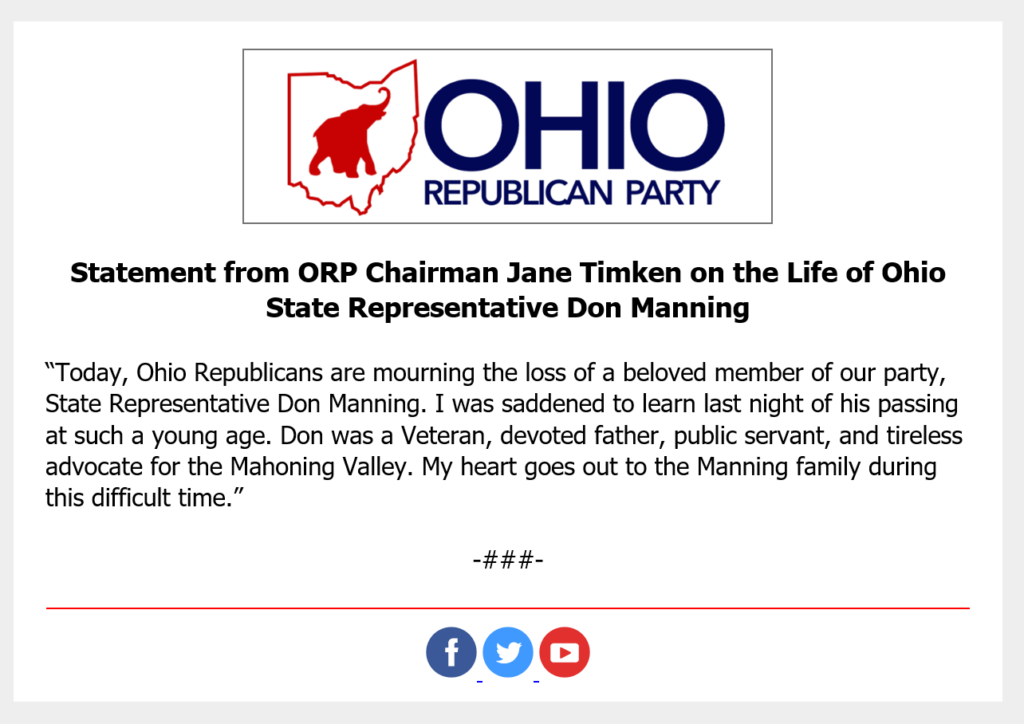
The Ohio House of Representatives is mourning the loss of a respected and beloved legislator today. Representative Don Manning (R-New Middletown) died Friday at the age of 54, Speaker Larry Householder announced.
Householder released a statement on Twitter after midnight Friday, stating “The Mahoning Valley and the State of Ohio lost one of their biggest fans and advocates yesterday. RIP Don.
“It is with a heavy heart that I regret to inform you that one of our fellow members has passed away. Representative Don Manning was a good friend and a good legislator, Don loved the Mahoning Valley and his work in the legislature,” Householder said.
The Speaker said he had very few details, other than that Manning was experiencing chest pains and was taken to a local hospital where he passed away.
Manning was serving his first term in the Ohio House. He represented the 59th District, which includes most of Mahoning County.
Each week, Ohio Statehouse News profiles one of our state legislators. Representative Thomas Patton (R-Strongsville) is our featured legislator this week.
Representative Thomas F. Patton is a lifelong resident of Cuyahoga
County. Patton is the son of a Cleveland police officer and the father of a
Cleveland Heights police officer who tragically died in the line of duty.
Patton has taken up many legislative initiatives pertaining to police,
firefighters, and first responders. Previously serving as a state
representative and then as a state senator, he returned to the Ohio House in
2016 to serve the 7th House District as the Majority Whip and in 2019 began
his second consecutive term.
Patton served in the Senate since 2008, and for the 131st General
Assembly, Patton was selected to serve as the Majority Floor Leader. He
served as the Vice Chairman of the Senate Transportation, Commerce and Labor
Committee, and was a member of multiple other committees including Finance.
Why did you become involved in government?
Back in July of 2001, I was asked to become involved in state government. I was a
little hesitant at first, so I told them I’d like to wait it out a little. Then 9/11
happened and something within me called me to serve. Several of my family members
have served in the military and being a part of state government was going to be my
way to serve the people of Ohio. It was the perfect time in my life to do so since
all six of my children were grown up by then. Serving in the House and Senate for
the past 18 years has been one of the most enjoyable parts of my life. I can really
see when us legislators are making a difference for the whole state.
What are your legislative policy priorities or goals for the upcoming
session?
I’ve been working on a PTSD bill for first responders and I’d like to see that make
some movement. A lot of people don’t think that PTSD can be affecting someone if
physical injury is absent, but that’s not true. The men and women who are serving
our country and serving our communities need to be protected when they’re most
vulnerable, just like they protect us when we’re the most vulnerable. We owe it to
them.
I’m also looking forward to finding a solution for the state’s current report card system and working to better Ohio’s foster care system. We need to prioritize Ohio’s youth and through bettering their education and home life, we can make the younger generations more prepared to be successful once they enter into the real world.
What surprises/unexpected challenges did you encounter when you
started?
In 18 years, there have been a lot of surprises. One thing that really surprised me
that didn’t take me long to figure out is the time and process it takes for a bill
to pass. But that’s just the tenure of our political environment.
I also didn’t expect to have such great relationships with the Democrats as I do. Ever since day one on Capitol Square, I realized that nothing will get done without cooperation from both sides of the aisle.
If you could change one thing with the state system, what would it
be?
Term limits. They’re not as productive as people want them to be. I believe that we
should increase the terms for state representatives to possibly four years.
Afterall, that four-year term works in the Senate. If you’re being productive as a
representative and your voters share the same thoughts, I believe you should be able
to stay and keep working to represent your district.
How do you stay in touch with your district?
I really enjoy going to local events around Cuyahoga County. I’m a part of a lot of
Facebook groups run by different community organizations, so I’m able to stay in the
loop of what’s happening and when it’s happening so I can be a part of it. It’s fun
to see and talk to constituents in a causal environment. I also make sure that I
never miss an Eagle Scout Court of Honor in the district. I always pass out my cell
phone number so that constituents feel comfortable reaching out to me with anything
they might need.
What is the most interesting/unusual request from a
constituent?
I was asked by a senior constituent to accompany him to re-take his Driver’s License
test. He passed!
Ohio is so diverse, what are the primary challenges you’re
facing?
I think one challenge that Ohioans are facing is the non-traditional route that kids
can take after high school to be successful in life. One of my constituents had a
son who was excelling greatly in his woodworking class. He ended up going to a trade
school and now works for a sheet metal union and is beyond successful. The challenge
we have is that so many parents think that if their kids don’t go to college,
they’re a failure. And that couldn’t be further from the truth. We need to continue
to push support for alternatives, like trade schools, to encourage students to find
his or her calling.
What have you done to help your district?
Out of all the things I’ve done to help Cuyahoga County the past 18 years, the one
that sticks out to me the most is my work fighting for an interchange between
Strongsville and Brunswick. We’ve been working with the Ohio Department of
Transportation to complete a study that will have all of the logistics and numbers
figured out for the partial interchange by the end of the year, but we still have
more work ahead of us until we get this thing built. I’ve listened to the concerns
of my constituents and I’m prioritizing their safety to increase the efficiency of
traffic between two of the biggest cities in our district.
How has your district benefitted from the budget?
I’m very proud of the work my colleagues and I put into this year’s budget. So many
positives have come out of it and directly impacted my district. For example, the
TechCred program has been a huge success in Northeastern Ohio. People are beginning
to feel more confident about finding jobs and retaining jobs. If we keep the job
market strong with programs like TechCred, we will draw more and more people to
Ohio, keeping it competitive.
Business is booming in grocery stores across the nation and Ohio is no exception. Shelves are being picked bare, with panicked shoppers stocking up on everything from essentials to all kinds of food in preparation for self-isolation and other implemented COVID-19 restrictions.
While other businesses are sending employees home, grocers are advertising for help online and in their stores. Online retail sales are booming as well, as Americans are being ordered to self-isolate.
Amazon sales have soared, and the retail giant said expects to add 4,600 jobs in the Buckeye state.
Kroger in St. Clairsville has a help wanted sign posted in the lobby.
“We’ve had a triple whammy here,” said a Kroger manager. “Anyone that isn’t feeling
well is told to stay home. Between an increase in online orders, employees
occasionally being off sick and restocking the shelves, we suffer being
shorthanded.”
The manager said that the store has experienced no shortage of supplies but keeping items on the shelves has been a real challenge. “We just can’t get them on as fast as they’re going off.”
Kroger, which owns Ralphs, Food4Less and other chains, is hiring an additional 10,000
workers in stores, manufacturing plants and distribution centers amid the
coronavirus outbreak, a company spokesman confirmed.
Kroger noted that jobseekers could be placed for employment within several days of
applying.
Staycee Saffell, a clerk at Riesbeck’s Food Markets in Barnesville, said that there has been a constant stream of shoppers in the store. Saffell said there has been no shortage of grocery items there either, only occasionally the bread is sold but is restocked as new trucks come in.
Riesbeck’s had a help wanted sign posted near the check out.
Saffell said she is not especially concerned about being exposed to the coronavirus. “We take precautions but when you are this close to people and handling the same items, there’s not much else you can do,” said Saffell.
Some of the hottest-selling items are water, bread, milk, eggs, soaps and detergents, said Saffell.
Amazon recently announced it would be adding 100,000 new employees to meet operational needs driven by online sales resulting from COVID-19 scare. About 4,600 of these jobs will be in Ohio, according to Owen Torres, a regional communications manager for Amazon Operations.
Amazon also is said to be raising its pay scale by $2 for employees in the U.S, according to the company’s blog.
An associate at Riesbeck’s in Cambridge said they also are hiring due to being short-staffed.
On the Indeed website, numerous retail grocer jobs in Ohio are listed at between $8 to $15 an hour pay rate.
Meanwhile, some grocers have had to close early to restock shelves and sanitize the
stores. Many have set aside hours for seniors only.
Dollar General announced its plans to dedicate the first hour of each shopping day
to seniors.
“Dollar General wants to provide these at-risk customers with the ability to purchase the items they need and want at the beginning of each day to avoid busier and more crowded shopping periods,” stated the retail store’s website.
Target stores began doing the same on Wednesday. The first hour of every Wednesday will be reserved for senior shoppers, according to Target’s website.
Walmart announced on Wednesday that it is changing its hours to 7 a.m. to 8:30 p.m.,
in an effort to give employees enough time to restock shelves.
Walmart will hold hour-long senior shopping for customers 60 and older beginning
March 24 through April 28,, according to its website. The store will open an hour
early for seniors each Tuesday. Pharmacies and vision centers will also be open.
Walmart and some other retail grocers have begun to set limits in certain categories, including paper products, milk, eggs, cleaning supplies, hand sanitizer, water, diapers, wipes, formula and baby food.
It’s looking more like students won’t be returning to school for the rest of the school year. Many schools continue to provide students with weekday breakfast and lunch.
Have no fear when the principle comes to call at your doorstep. He’s probably just there to deliver lunch.
Numerous school districts across Ohio are making free meals available to students who otherwise would not have access to weekday breakfast and lunch during school closures. Some districts are preparing food for pickup by families in need and some are delivering meals to students’ doorsteps.
All Ohio schools were ordered closed by the governor and will likely remain closed for the rest of the school year. The Ohio Department of Education is asking schools to continue providing meals to students in need even though the schools are closed.
“One of Ohio’s highest priorities during the ordered school-building closure period, which seeks to diminish the spread of the coronavirus (COVID-19), is to ensure that students receive nutritious meals,” the department’s updated guidelines state. “This is fundamental to supporting the whole child.”
The department issued updated guidelines that say it will continue to reimburse schools for meals served to students during the forced closure and that school districts should file applications as soon as possible to ensure a smooth transition.
The education department is directing schools not to deny meals to those students who don’t ordinarily qualify.
In East Ohio, school administrators are preparing and delivering meals to families in the Barnesville Exempted Village School District. Elementary school principal Clint Abbott said the school is running five routes delivering meals to children.
Abbot said there are about 33 families on the list, some with multiple children.
School administrators prepare and deliver the meals themselves. Some of the food is provided by local churches.
The principle said five days of food is delivered at a time. What is in the lunch bags often depends on what foods have been donated by local churches. “It’s mostly healthy food,” said Abbot. “Foods that can be eaten by the family.”
Abbot said, for example, the meals sometime include mac & cheese, fresh fruit and vegetables, milk and bottled water, cracker snacks, Lunchable-type food, and soups in packets and cans. Abbot said bread and strawberries were part of recent delivered lunches.
With no date in sight for reopening, Abbot said the school will continue offering the free meals for as long as needed.
Abbot said that the school principals and superintendent, as well as the transportation director and cafeteria supervisor are some of those involved in preparing and delivering lunches.
Any other families in need are encouraged to contact the school. “We encourage them to reach out to us,” said Abbott.
Barnesville Superintendent Angie Hannahs said the administration is discussing a long-range plan to provide meals that would include delivery to meeting sites.
There are about 1400 students in the Barnesville school district.
Kids in the Bridgeport Exempted Village School District in Belmont County will have hot lunches available for pick up, according to Superintendent Brent Ripley.
Ripley said the district serves anywhere from 300 to 400 meals a day when school is in session and he anticipates 150 to 200 meals a day will be picked up. The program begins Thursday and will operate two days a week. Several meals could be picked up at one time, said the superintendent.
A hot lunch will be offered as well as a grab-and-go type breakfast, said Ripley.
The Shaker Heights School District in Central Ohio is taking requests from families of students who need meals while school is out. It plans to provide free breakfast and lunch to students pre-kindergarten to 12th grade from March 18 through March 20 and again from March 30 through April 3.
“Daily meals will include lunch for that day and breakfast for the next. Our options for meal items may be limited and may not meet individual dietary needs or allergy restrictions,” stated the Shaker Heights School District guidelines. “Students with food allergies should use caution before consuming these meals.”
Cincinnati Public Schools’ Student Dining Services will be distributing meals from 11
a.m.–1 p.m. Tuesday to April 3, on Mondays, Wednesdays and Fridays each week, with
an additional serving day of Tuesday, March 17.
On Mondays and Wednesdays, children will receive two breakfast meals and two lunch
meals. On Fridays and Tuesday, children will receive one breakfast meal and one
lunch meal. All meals will exceed USDA nutritional requirements and will be
available on a first-come, first-served basis.
The 2020 Census could mean unfortunate changes for Ohio; Meanwhile the Census Bureau is facing challenges of its own.
Ohio is predicted to lose one congressional seat after the 2020 census and several Ohio cities could be reclassified as villages due to population shifts.
The state is expected to be about 73,000 residents short of the number needed to keep its 16 congressional seats. There are only 435 seats to go around and states that haven’t kept pace will have to shed a member of the U.S. House of Representatives to make up for the gainers.
Ohio and neighboring Pennsylvania, Michigan and West Virginia are among the states in line to lose congressional seats after the census, according to an analysis of the new state-by-state population estimates.
The federal government has conducted a census every 10 years since 1790. The information is used to determine funding and the number of Congressional representatives states receive.
Households across the nation began receiving Census Bureau notices on Thursday.
About 80% of those receiving notices will be encouraged to fill out questionnaires online. The other 20%, who live in areas with low internet access, will be given paper questionnaires to be filled out and mailed back.
Those who fail to reply online, by mail or by telephone will receive an in-person visit by a census-taker.
This would mark the sixth consecutive decade in which Ohio would have a dwindling influence in Congress. Ohio had 24 congressional seats in the 1960s, dropping after each census since then, to 23 in the 1970s, then to 21, 19, 18 and finally 16 after the 2010 census.
Likewise, A population of 5,000 is required for city status in the state. With several Ohio cities teetering at just slightly over 5,000, city officials are urging citizens to be sure and fill out the census form so that no one goes uncounted.
The cities below could be reclassified as villages if their population drops below 5,000.
The census count allocates federal dollars for infrastructure, such as bridge and roads, and for services like community development grants, nutrition programs and health funding. Beyond services, an accurate count will serve as a basis for appointing congressional seats.
Meanwhile, as the Federal Census Bureau is urging Ohioans to participate in the count, the Bureau itself has been faced with numerous challenges, the most recent being the coronavirus outbreak.
Meeting its goal of 500,000 census-takers is proving to be more difficult than anticipated.
To ensure an accurate count, census-takers will try to track down those who do not respond by late April and begin knocking on doors.
With emerging virus concerns, some of the Bureau’s temporary workers have expressed concern and are re-thinking their decision to work.
“There’s no question that the coronavirus crisis has created an unexpected and significant new challenge to conducting a successful census on time in all communities,” said Terri Ann Lowenthal, a census expert. “No one knows exactly how this health crisis will affect census operations.”
Lowenthal said it’s likely that it will have to modify some of its operations.
The Census Bureau reportedly also has faced shortfalls in its IT systems, cybersecurity and partnership development.
Census workers are still being hired for door-to-door positions that pay anywhere from about $15 to $21 per hour, depending on location.
“More people might be reluctant to take this kind of job since it involves going door to door and talking with strangers,’’ said Lowenthal, former staff director of the House census oversight subcommittee.
“It’s possible that some residents might be reluctant to open their door to what is essentially a stranger,” she added.
Lowenthal said it’s more important than ever to promote responding online, by phone or by a paper questionnaire.
“That will be the easiest and safest way to make sure your household is counted especially at a time of so much uncertainty,” she said.
About 60% of US residents are expected to respond to Census questions online.
Among cities on the cusp of losing their “city” title is St. Clairsville, Ohio, in Belmont County. Anything under five thousand is considered a village, and this East Ohio municipality will be cutting it close.
St. Clairsville Mayor Kathryn Thalman encourages participation in the Census.
“I just hope people take this seriously, because it could mean the difference between us being a city and a village,” said Thalman. “We want everyone to know that everybody counts, and we want to make them count.”
Thalman noted that the city is wrestling with infrastructure issues, particularly to meet mandates for water service made by the Ohio Environmental Protection Agency.
Village status could make a difference in the amount of funding available to meet those mandates. “We know that grants are often tied to being a city,” Thalman said. “Yes, that could make a difference.”
These states are among those expected to lose representation in the US House of Representatives:
* Losing two seats: New York (to 25).
* Losing one seat: California (to 52), Illinois (17), Ohio (15), Michigan (13),
Pennsylvania (17), Minnesota (7), West Virginia (2), Rhode Island (1).
* Gaining one seat: North Carolina (to 14), Arizona (10), Colorado (8), Oregon (6)
and Montana (2).
* Gaining two seats: Florida (to 29)
Each week, Ohio Statehouse News profiles one of state legislators. Representative Mark Fraizer (R-Newark) is our featured legislator this week.
State Representative Mark Fraizer serves the 71st Ohio House District. Fraizer was born and raised in the city of Newark. He has served as a Newark City Councilman since 2016, where he contributed to the successful removal of discriminatory BSL legislation, the expansion of Community Reinvestment Areas in key locations, and the cultivation of advancement and growth throughout city. He was the Chair of the Economic Development Committee and a member on the Finance, Safety, Rules and Recreation Committees on City Council. Rep. Fraizer earned his Bachelor of Arts in Business Administration with a minor in Economics from Otterbein University. He is a Sr. Project Manager at Huntington National Bank. He previously served on the boards of the Historic Hudson Community Association and continues to serve on the board of Invest Hope, a non-profit that serves underserved communities in Haiti. Fraizer was the primary sponsor on three key pieces of legislation while serving in the House and co-sponsored 17 bills. Fraizer was recognized with a National Security Leadership Award from Mission: Readiness Ohio while serving in the state legislature.
Why did you become involved in government?
I became involved in politics because I wanted to help and support our local
community. I have lived in Newark my whole life and I’ve seen the great potential it
has, along with the rest of Licking County. Being a part of Newark City Council was
just the start of my political involvement. It’s been an honor to serve Licking
County as State Representative and I look forward to my continuous service.
What are your legislative policy priorities or goals for the upcoming
session?
Although I have many legislative priorities for the upcoming session, my key
priorities include economic development and easing the use of tools for local
government. I also plan on sponsoring legislation that will assist the aging and
disabled population.
What surprises/unexpected challenges did you encounter when you
started?
The legislative process for how a bill becomes a law is actually very complex.
Between the beginning stages of hearings and testimonies, to the passage by both
chambers, to the signing by the executive branch, it’s a long, comprehensive
process.
How do you stay in touch with your district?
I stay in touch with my district primarily through attending events and gatherings
throughout Licking County. I like to get out and talk to constituents and I maintain
and open-door policy to encourage my constituents to reach out to me.
What is the most interesting/unusual request from a
constituent
I’ve received a few unusual requests involving exotic and wild animal laws.
What are some of the attractions or hotspots in your
district
Our district contains the Newark Earthworks and Hopewell Indian Mounds, Longaberger
Basket Building, adjacent to Dawes Arboretum, revitalized Downtown Newark with the
Midland Theatre, and numerous parks and quaint communities.
Ohio is so diverse, what are the primary challenges you’re
facing?
There is a lot of diversity in Newark. The needs for consistent educational funding,
sustained economic growth, and infrastructural investment are all major items facing
Ohio and Licking County.
What have you done to help your district?
During my time on City Council, I created two councils: The Mayor’s Council and The
Economic Development Council. Both councils have greatly benefitted the community
through government streamlining. During my time as State Representative, I’ve helped
my district through sponsoring and supporting legislation to empower local
government, support healthcare transparency and protect religious liberties and
freedoms. I’m going to continue to work towards organizing and driving out solutions
and funding opportunities to address transit, zoning, infrastructure and
intergovernmental cooperation.
How has your district benefitted from the budget?
Although I was appointed into the House after the budget passed, Licking County has
still benefitted from it. We have been able to receive additional funding for
education services, children’s services and transportation services, along with a
huge income tax cut. I’m looking forward to being a part the next biennium budget.
Most people think the gas chamber was long ago replaced with more humane methods of euthanizing shelter animals. So did Ohio Representative David Leland, until a constituent came to him with concerns that the cruel practice is still being utilized.
This prompted Leland (D-Columbus) to devise a bill that would end the inhumane method of euthanizing domestic animals once and for all.
The legislation now has a joint sponsor Rep. James M. Hoops (R-Napoleon) and has become a bi-partisan bill with numerous cosponsors, said Leland.
Erie County Dog Pound in Sandusky, Ohio, reportedly is one of the few remaining shelters still using carbon-monoxide gas to euthanize unwanted pets. The warden was not available for comment about why it’s still in use and to what extent. The warden did not return phone calls.
“This is not done to the extent that it used to be done,” said Leland. “The fact that it’s allowed in Ohio, that this is not prohibited, is an issue.”
Leland said he wants to ensure that no pets are subjected to this ever again in the state.
“When shelter animals have to be put down, it should be done with the compassion we would expect for our family pet,” said Leland. “While the use of gas chambers in shelters has become a rarity in this state, we are one of the few that still allow it to happen at all. Passing this bill will demonstrate Ohio’s commitment to treating animals humanely at every stage of their lives.”
This isn’t the first time a bill to ban the gas chamber has been put before the Ohio legislature. A similar bill failed in 2018.
“This seems to have a lot of support,” said Leland. “But it’s not a slam dunk, so to speak. Even though most people are horrified at the thought of animals being gassed. This has been tried before and was not successful.”
Leland said it’s important to make legislators aware of your thoughts on the matter through telephone calls and emails.
Ohio is one of only four states in the nation that still uses this practice to euthanize in shelters.
Various animal rights organizations, such as the Humane Society of the United States and the Ohio Society for the Prevention of Cruelty to Animals, have publicly denounced the practice of euthanizing animals using gas.
An animal can survive in a gas chamber for as long as 25 minutes.
Under the best circumstances, an animal loses consciousness after a few minutes. If the chamber is poorly maintained or if the animal is very young, very old, ill, injured or stressed, it can take much longer. In the worst cases, the animal is still conscious while its vital organs begin to shut down.
The Humane Society recommends using sodium pentobarbital to euthanize animals.
A study commissioned by American Humane in 2009 comparing the cost of the gas chamber to Euthanasia By Injection (EBI), it determined that EBI cost less than half, $4.98 per animal vs $2.29.
The bill only protects domestic animals. At least two counties in Ohio reportedly continue to use the gas chamber for wildlife, Butler and Knox counties.
Leland said he would consider having wildlife included in the bill but that he would need to research the issue further. “This could be added later in the process and I would be very open to having conversations about that,” Leland said.
There is also legislation in the senate that would end the practice of gassing.
Senator Kenny Yuko (D-Medina) introduced legislation in February that would prohibit putting down domestic animals by use of the gas chamber.
Senate Bill 167 states that no person shall recklessly destroy any domestic animal by the use of a any high altitude decompression chamber or carbon monoxide gas chamber.
The bill prohibits any method other than one that immediately and painlessly renders the domestic animal initially unconscious and subsequently dead.
Yuko’s bill, however, does not include wildlife and does not prohibit the use of gas chambers in the slaughtering of livestock.
Legislation is coming soon to end the death penalty in Ohio, a bipartisan group of state senators announced.
Repost: State Sen. Nickie J. Antonio (D-Lakewood) is calling for the death penalty to be replaced with life without parole.
The bill will be introduced in the coming weeks, she said in a news conference.
“The death penalty is expensive, inhumane, impractical, unjust and often erroneous. Abolishing it is a practical solution,” Antonio said.
“This is not a Republican or a Democratic issue. No matter what a person’s reason is for supporting this legislation, we all agree that this is critical for our own collective humanity. It is our responsibility to work together across party lines and legislative chambers and move forward to end the death penalty in Ohio.”
Antonio has introduced similar legislation in every General Assembly in which she’s served since 2011.
This is the first time, however, the bill has bipartisan support in the Senate.
State Sen. Peggy Lehner (R-Kettering) will be a joint sponsor of the bill and Sen. Kristina Roegner (R-Hudson) plans to be a co-sponsor.
Ohio leaders have been debating the future of capital punishment as the state struggles to find a supply of lethal injection drugs.
Gov. Mike DeWine delayed seven executions last year and asked the Department of Rehabilitation and Correction for a new execution protocol after drug makers threatened to cut off access to medications if Ohio used them for executions.
House Speaker Larry Householder (R-Glenford) has said his caucus is having in-depth discussions on the issue and recognizes Ohio has a death penalty law on the books that the state can’t enforce.
Those internal discussions are continuing, Householder said Thursday.
State Rep. Bill Seitz (R-Green Township) said he will oppose the bill to abolish the
death penalty: “It needs to be retained for terrorists, mass murderers and the
like.”
He’s skeptical the legislation will make it out of the Senate.
“I do not predict where the House would be, but I doubt the Senate would pass it. They still haven’t passed the House-passed bill that would remove the death penalty as applied to the seriously mentally ill— so why would anyone think they would abolish it altogether?”
A Gallup poll released in November said 60 percent of Americans indicated they believe life in prison without parole is better punishment than execution, but 56 percent support it for convicted murderers.
By Jennifer Edwards Baker
Repost from CINCINNATI (Fox 19); Copyright 2020 WXIX. All rights reserved