The Senate rejected changes made to SB 89 by the House on Wednesday, leaving many
families in limbo while lawmakers continue their search for a solution to Ohio’s
private school voucher program.
The bill initially focused on career-technical education but was amended by the House
to address the EdChoice Scholarship Program and other topics.
The Senate voted 24-7 to scrap the House changes.
The Senate argued that the plan was not ready for passage, pointing to an ongoing
conference committee process on a Senate voucher proposal, HB 9, as the more
appropriate bill to fix the issue.
SB 89 has statewide support from education groups.
State Representative Jamie Callender (R-Concord) explained that the House and Senate
have slightly different views and the leadership is working them out.
As for Ohio families that are awaiting an answer, Callender said, “Speaking from the
House side, we are cognizant of the impact this has on them and we are working
diligently to reach a responsible solution.”
Senator Andrew Brenner, who voted to reject the changes, said he saw numerous
problems with the bill. “They added a lot of Ed Policy in there that really needs
some work,” said Brenner.
Brenner said that it’s more likely the Senate will move forward with HB 9. “That
seems like the more intelligent approach to me, instead of conferencing on a bill
with the exact same stuff,” he said.
This recent action sets the stage for dueling conference committees, one in support
of SB 89 and the other in support of HB 9. Both could potentially address the
voucher issue.
Without legislative action, the list of schools in which students are eligible based
on their school’s performance would more than double to about 1,200 for the
2020-2021 school year.
The Senate proposal would keep the current numbers while expanding the eligibility
threshold for vouchers available based on family income from 200 percent of the
federal poverty guidelines to 300 percent.
Each week, Ohio Statehouse News profiles one of our state legislators.
Representative Thomas E. Brinkman Jr. (R- Mt. Lookout) is our featured legislator
this week.
Rep. Brinkman is serving his third term as state representative. A
life-long Cincinnati resident, Brinkman is a graduate of George Washington
University in Washington, DC. He represents the 27th Ohio House
District, which includes portions of eastern Hamilton County.
Why did you become involved in government?
I wanted to impact public policy to make Ohio a better place to live.
What are your legislative policy priorities or goals for the upcoming
session?
Lower taxes and limit
government.
What surprises or unexpected challenges did you encounter when you started.
An unwillingness to make Ohio a leader in ANYTHING!
If you could change one thing with the state system, what would it be?
Stop the appointment process to fill vacated elected positions. Have a placeholder
fill the seat and let the citizens petition to stand for election them compete and
win or lose.
How do you stay in touch with your district?
Drive home from Columbus every day after session. I have not spent a night in
Columbus in over 13 years in the Ohio House.
what is the most interesting/unusual request from a constituent?
Will you be my friend? Of course!
What are some of the attractions or hotspots in your district?
The Little Miami River Valley which has many different park and recreational areas.
Ohio is so diverse, what are the primary challenges you’re facing?
We are a diverse state and bridging the divide is hard.
What have you done to help your district?
Improved the quality of life by supporting personal freedom, and park and
recreational facilities.
Lawmakers held the first hearing on House Bill 468 Tuesday, legislation
that would make distracted driving a statewide primary offense.
Using a cellular device while driving currently is a secondary offense in
Ohio, meaning police must witness another offense before pulling over a driver.
Representative Mary Lightbody (D-Westerville) said the purpose of the bill
is to keep Ohioans safe.
“What we’re doing is making it a primary offense to be using your handheld
electronic device while you’re driving, other than just in a very few ways,” said
Lightbody, who represents Ohio District 19, including part of Franklin County.
“The whole goal of this is to keep people safe on the highway, including
nearby pedestrians,” said Lightbody. “If you can engage with your device wirelessly,
without touching your device, that is allowed. You cannot engage or interact with a
game or view Netflix.”
Lightbody said use of navigational apps would be acceptable, as long as the
device was not being held in the driver’s hand.
“You can dial and receive a phone call, but you cannot conduct the call
with the device in your hand,” said Lightbody. “The conversation has to be wireless
or through speaker phone.”
The bill is in the Transportation and Public Safety Committee.
The legislator said it is already a primary offense in some cities and
municipalities in Ohio to use a cellular device while driving, including Columbus,
Bexley and Westerville.
Auto insurance companies and law enforcement support the bill, she said.
Lightbody said that police officers detect use of phones by watching the
behavior of drivers.
“Anyone who is driving erratically, they can approach and look to see what
the driver is doing,” said the legislator. “There’s a police officer in Columbus who
has been very active in enforcing Columbus’s primary offense law. He looks for an
activity called head bobbing. He holds his body cam up to the window, so he’s
documenting that this person is using their call phone.”
In response to those that feel the law would be too far-reaching, Lightbody
said, “There are laws that govern how we drive, like stopping at a stop sign or
staying within the speed limit. This would be one of those laws. The whole point is
to keep everyone safe including the drivers of those cars, passengers and nearby
pedestrians.”
Governor Mike DeWine previously stated that he supports making distracted
driving a primary offense in order to curtail the number of deaths and crashes
caused by inattentive drivers.
A revised petition to allow Automatic Voter Registration on Ohio’s November ballot
was submitted to state officials Monday.
The filing is the first part of a multi-step process that eventually will require the
campaign to gather signatures from hundreds of thousands of Ohio voters so that the
measure can be placed on the ballot.
Under the proposed constitutional amendment, Ohioans would automatically be
registered to vote upon applying for or renewing a driver’s license or other
state-issued ID. Supporters of automatic registration say that it increases turnout,
allows for updating and correcting voter rolls, and aligns with the goal of election
security.
The first draft was rejected by the the Ohio Attorney General because the summary was
longer than the language for the actual constitutional amendment. The office also
said the summary included a paragraph of text that’s not included in the amendment.
Opponents of Automatic Voter Registration argue that it threatens election security,
creates an administrative burden on election officials, and encourages ill-informed
voting.
Members of “Secure and Fair Elections” and a collection of voting rights advocates
delivered the revised petition. The coalition is led by the ACLU of Ohio
.
Twenty-one states currently have same-day voter registration. About a dozen more
have some manner of automated voter registration, according to the National
Conference of State Legislatures.
Per the Attorney General’s request, the updated summary is what advocates will use
when circulating the initiative for signatures.
The group will need to collect about 443,000 valid signatures by July to qualify for
the November ballot.
The measure would reinstate and expand what previously was referred to as “Golden
Week,” which state lawmakers eliminated in 2014. Another element of the proposed
amendment is a required, statewide post-election audit.
Proof of residency is a key requirement in all states that offer same day
registration.
In a traditional (pre-Election Day) registration, which is what Ohio currently uses,
election officials have time to send a non-forwardable mailing to the prospective
voter in order to verify the voter’s residence before processing the registration
application.
Because that isn’t possible with AVR, the prospective voter must present proof of
residency at the time of registration or soon after registering. A current driver’s
license or ID card will suffice in all states. In some states, documents such as a
paycheck or utility bill with an address is acceptable for proving residence.
A few states also permit an already-registered voter to vouch for the residency of an
Election Day registrant.
Other elements of the proposal would put guarantees in writing that military service
members and overseas citizens receive their ballots on time and that voters with
disabilities have equal access to the polls.
The Attorney General’s office said in a statement that its role is to determine
whether the summary is a “fair and truthful representation of the proposed the
group acknowledges that rejected petition language is a common practice and it says
they will be refiling.”
A few days ago, Ohio Democratic Party Chairman David Pepper penned a bizarre
screed attacking U.S. Rob Portman, R-Ohio, by alleging some imaginary misdeed
involving Ukraine.
David Pepper, then a candidate for Ohio attorney general, speaks with
The Enquirer’s editorial board on October 2, 2014. The Enquirer/Leigh
Taylor (Photo: The Enquirer/Leigh Taylor)
If you follow Pepper on Twitter, this will be nothing new. Pepper has an
almost maniacal obsession with trolling Senator Portman. Ever since Portman’s
reelection in 2016, Pepper has been assailing him daily.
It’s not clear what Pepper’s problem is with Portman. They’re both from Cincinnati,
raised by successful families and attended top-notch universities. The only stark
difference between them is their careers.
Portman is a highly respected and successful politician by both election and
appointment. He has been elected seven times to Congress and twice to the Senate. He
has served as a director of the Office of Management and Budget and U.S. trade
representative.
Pepper’s career in public service is less impressive. He was off to a pretty good
start getting elected to Cincinnati City Council, but then lost a campaign for
mayor. Then he was elected as a Hamilton County commissioner in 2006, and that
was his last winning election for public office. In 2010, he ran for auditor of
state, losing to Dave Yost, and then for attorney general, losing to Mike
DeWine.
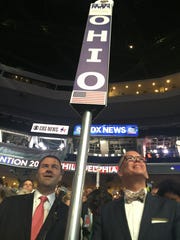
Ohio Democratic Party Chairman David Pepper, left, with Cincinnati’s Jim
Obergefell, at the Democratic National Convention in July. (Photo:
The Enquirer/Jason Williams)
In 2015, Pepper was elected chairman of the Ohio Democratic Party.
A state party chairman has one job, and that is to elect members of their party
to public office. To get that job done, you only have to do two things: raise
money and recruit good candidates. To be fair, there’s a lot of work that goes into
completing those two tasks to achieve that singular goal. I know, because I did
it for four years as chairman of the Ohio Republican Party.
By both measures, Pepper and the Ohio Democratic Party haven’t done very well.
The 2018 election was THE big year for Democrats; midterm elections tend to be a
disaster for the party in the White House, and all five statewide offices were
open seats. Democrats had some success in many states that year, but not Ohio.
Republicans swept all five statewide offices that “Democrat
wave” year.
Using nearly every possible metric, the party is failing this cycle, too. A
Republican supermajority in the state Senate. Check. A near 2-to-1 Republican state
House majority. Check. A strong and vibrant GOP congressional delegation chock full
of key committee slots and nationally recognized party leaders. You betcha. Of
course, there’s all those statewide constitutional offices Republicans hold
– with officials who are popular and working alongside a robust Ohio Republican
Party.
And if all that weren’t enough, consider that just this week it was announced
Ohio’s Republican Supreme Court candidates outraised their likely Democratic
opponents nearly 15-1. That’s a staggering amount and illustrates the stark
comparison between a vibrant Republican Party and state Democratic Party lacking
leadership and aimlessly adrift.
Sen. Rob Portman, R-Ohio, arrives at the Capitol in Washington
during the impeachment trial of President Donald Trump on charges of abuse
of power and obstruction of Congress, Thursday, Jan. 23, 2020. (AP
Photo/Julio Cortez) (Photo: Julio Cortez, AP)
You may be wondering why a lifelong Republican would care about the fortunes of the
Ohio Democratic Party.
Strong Republican and Democratic parties provide stability and create healthy
competition. Like Ray C. Bliss – the legendary county, state and national Republican
chairman – I believe the two-party system is the key to the past success and
future of our republic. That’s part of it.
Another part of it, I’m tired of Pepper’s one-man rant against Portman. Rob
Portman is the kind of thoughtful, talented and hardworking politician that succeeds
in Ohio. I like our senator and so do many Ohioans; he won his first election by 18
points and his reelection by 23 points! Frankly, Pepper trolling Portman is getting
old.
The last part of it is an act of compassion. Pepper can’t be enjoying life very
much behind a laptop or mobile phone hurling insults at Portman. Pepper has become
the Jim Harbaugh of Ohio politics.
Kevin DeWine is a former Ohio Republican Party chairman and speaker pro tem of
the Ohio House of Representatives.
The Ohio Republican Party’s governing body withdrew its endorsement
of legislative candidate Joe Dills Thursday night, citing concerns about the
candidate’s activity on a married dating website.
Dills had the endorsement of the state Republican party until information recently
surfaced of Dills’ involvement with the Ashley Madison site. This prompted the Ohio
Republican Party Chairwoman, Jane Timken, to ask that Dills leave the race for the
65th House District, but Dills refused.
The candidate admitted on Facebook that he had an Ashley Madison account while a
single man in 2013. In an email to cleveland.com, Dills reportedly said that while
it was “wrong” for him to join the site, he intended to stay in the race.
“It has come to my attention that there is additional information regarding Mr. Dills
using a second account on Ashley Madison while he was married to his current wife,”
Timken said, in a statement. “I want to be clear, Ashley Madison is a site for
discreet affairs – affairs between married people.”
Dills, of Union Township, is one of three Republicans running for
the 65th House District seat, along with former U.S. Rep. Jean Schmidt and
pistol instructor Dillon Blevins. The district includes northern and western
Clermont County.
Timken continued, “Moreover, Joe emphatically declared he never used this site while
married to his current wife. I feel for his family in this time, and wish that he
would have been open and transparent when the initial report came out,” said the GOP
chairman. “I stand by my previous statement and urge him to do what’s best for his
family and community – immediately withdraw from this race.”
Ohio GOP Communications Director, Evan Machan, said the organization recently
received additional condemnatory information about Dills.
“Starting on Friday, January 24, we received information stating that Joe Dills had
actively used the website Ashley Madison to meet married women,” stated Machan.
“Upon receiving these reports and in an effort to shield Joe’s family from public
embarrassment, at my request, and through back channels we asked Mr. Dills to
withdraw from the race.”
Machan stated that the back channel discussions deteriorated and Dills stated
publicly that he would not withdraw and that he never used these sites while married
to his current wife.
“Early this week, we received new reports that this was far from the truth,” Machan
said in the statement. “Starting with the Cincinnati Enquirer publishing that his
wife had shown up to his work and, “believed her husband was having an affair*
followed by a report that he had another Ashley Madison account that was active in
2015 – a year after him and his current wife were married – it was clear that Mr.
Dills lied to the public.”
*Source: Miami Township Police Report, Incident Number 1-16-000904, Narrative
Reporting Office Steven Burgess
Earlier Thursday, the House GOP’s campaign arm reportedly gave state party leaders
116 pages of opposition research about Dills. The document detailed tax liens,
traffic records and allegations of shoving his ex-wife.
“Joe Dills clearly isn’t ready for this public exposure. It’s only going to get
worse,” according to the document which included research by FAR Public
Affairs, LLC.
Timken said she did not know the firm that had prepared the report but it contained
mostly public records.
The alleged abuse was detailed in a background investigation report completed when
Dills applied to the Ohio Highway Patrol in 2015. In the report, Dills’ first wife
said he “grabbed her arm, picked her up and slammed her on the ground”
during a heated argument in 2010.
Dills’ ex-wife did not report the incident to police at the time and told the Ohio
Highway Patrol investigator that it was the only time Dills had laid a hand on her,
according to the background report. Dills told the patrol investigator that he was
defending himself and had never struck a woman.
State party officials reportedly verified the dating site information by comparing it
to their own copy of the Ashley Madison files that were leaked in 2015 after the
site was hacked, according to a GOP official. Following the hack, the state party
downloaded all of the hacked files, which contain data on about 32 million users.
The files can be searched by the public as well, via searchable websites.
Each week, Ohio
Statehouse News profiles one of our state legislators. Representative Dave
Greenspan (R-Westlake) is our featured legislator this week.
Greenspan is serving his second term in the Ohio House of Representatives. Prior to
this, the legislator served on the Cuyahoga County Council. He represents the 16th
Ohio House District, which includes the cities of Bay Village, Fairview Park, North
Olmsted, Rocky River and Westlake in Northeastern Ohio.
Why did you become involved in
government?
My grandmother told me if you want to give something truly valuable, give of your
time. Government service enables me to give back to the community. I’ve always had
an interest in public policy. In 2010, I was encouraged to run for county
government. Several years later, here I am serving at the state level.
What are your legislative
policy priorities or goals for the upcoming session?
My priorities focus around local government, law enforcement, anti-bullying and
anti-hazing, sports gaming, quality of life issues, mental health and deadly weapons
due process protocol and government transparency.
What surprises/unexpected
challenges did you encounter when you started?
We have a very diverse population in this state. One of the challenges is responding
to the different sets of needs between the rural, suburban and urban areas. For
example, in urban areas you’re dealing with things like food insecurity and public
transportation. The suburban and rural areas have their own unique sets of
challenges. You need to find a balance between what is important to your district,
and what is important to the state as a whole
If you could
change one thing with the state system,
what would it be?
Something that stands out in my mind is that much of Ohio’s infrastructure dates back
to World War II era. Aging infrastructure and water systems is a problem for
communities across Ohio.
How do you stay in touch with
your district?
If an individual reaches out, I call them back personally whenever possible. I also
stay in touch with my constituents through a quarterly newsletter, social media,
outreach events and town hall meetings. We have a monthly radio show, The
Advocate on 1420 AM, in Cleveland.
What are some of the attractions or hotspots in your district?
We’re fortunate to have so many attractions and things to do. To name a few, there’s
Huntington Beach on Lake Erie, which is very popular, Huntington Playhouse, Rocky
River and Crocker Park in Westlake.
Ohio is so diverse …
what are the primary challenges you’re facing?
Again the different needs of rural, suburban and Urban parts of the state.
What have you done to help
your district?
I’ve been fortunate to have numerous bills passed that have benefitted, not only my
district, but the state. In my district, Bay Village emergency response boathouse,
funds to shore up historical buildings, to rebuild the Nature and Science Center,
Bayarts, Fairview Park community center-Red Cross relief shelter, North Olmsted
emergency services so that they can communicate more effectively, just to name a
few.
Republican Representative J. Todd Smith (R- Farmersville) recently indicated he will
not seek re-election for his Ohio House seat. This ends a Republican primary battle
between Smith and Preble County Commissioner Rodney Creech. Creech will face
Democrat Amy Cox in November.
The district has been Republican controlled since 2014 but is considered in play by
the House Democrats who remarkably shared with Cleveland.com that they are focused
on winning only two Ohio House seats this November.
“House Democrats this year are aiming for the more modest goal of picking up the two
additional seats needed to erase the House GOP’s 60-seat supermajority, which allows
Republicans to override gubernatorial vetoes and put measures on the statewide
ballot without Democratic votes,” Jeremy Pelzer, Cleveland.com.
Is the lack of effort from the House Democrats a sign of overall failed party
leadership? The last time Democrats controlled the Ohio House was in 2009 when
Armond Budish was Speaker for two years. His tenure ended at the same time former
Democrat Governor Ted Strickland lost after only one term.
Since that time the Democrat party has failed to obtain any significant wins with the
exception of U.S. Senator Sherrod Brown.
We asked political operative and former Chief Operating Officer for the Ohio Senate,
Neil Clark, if the Democrat party is all but throwing in the towel in Ohio by
setting such a low bar to win back seats in the House?
Clark explained that he doesn’t think so, and he actually thinks the Democrats had a
resurgence through using Instant Voter Registration and the issue of redistricting
to make Ohio more competitive.
He went on to explain that Republicans have been successful in the past without
creating ballot initiatives or wanting to redraw district lines because their
primary focus is on policy issues and how they can message those to the public. He
believes that by remaining focused on those strategies, Republicans will keep their
power.
Legislation in the Ohio House would require pole-to-pole safety netting in Ohio
ballparks by the start of the 2021 season. The bill was introduced in response
to serious injury to spectators at Major and Minor League Baseball games.
Some ballparks are being proactive and have already extended or have plans to extend
their protective netting. House Bill 479 would make this
mandatory for the ones that haven’t taken the initiative.
“Baseball players are getting bigger and stronger each year, while fans are sitting
closer to the action,” said Representative Rick Perales ( R-Beavercreek)
who introduced the bill along with Representative John Patterson
(D-Jefferson).
A baseball can be hit in excess of 100 mph by top
batters
“There have been a number of incidents in Ohio and around the country with people
being seriously injured, sometimes killed, with foul balls and bats landing in the
lower levels of the stadium,” said Perales.
“Many professional groups have taken it upon themselves to install netting as a
safeguard,” Perales added. “This bill is simply requiring it of all Ohio
professional teams.”
Patterson got involved with the issue when a constituent reached out to him with
concerns about safety in ballparks.
The constituent, Dina Simpson, 46, was permanently blinded in one eye after being
struck in the head with a line drive. Simpson was sitting with her family at a Lake
County Captains game, a Single A Farm Club for the Cleveland Indians.
Simpson has been pushing for legislation to require netting since 2017 when the
injury occurred.
“I couldn’t say no,” said Patterson. “This just makes sense.”
It just so happened that, prior to being a legislator, Patterson’s dream was to be a
college baseball coach. Incidentally, he said, Urban Meyer used to play for him on a
American Legion team years ago.
“Our job as Ohio lawmakers is to protect Ohioans,” said Patterson. “Fans have been
moved closer to the action over the years and pitchers are throwing harder than
ever. Then there are distractions, mainly cell phones, and that’s a mix for
tragedy.”
Patterson noted that the safety netting would be retractable. Once a game begins,
however, the fans would need to be protected.
Currently, many ball fields have safety netting in the dugout areas. The law would
require netting along the first and third baselines, from the end of the dugout to
the outfield foul poles. The outfield would not require netting.
Perales said that it has yet to be decided which legislative committee will be
looking at specifics on the bill.
“We wanted to get this conversation started,” said the lawmaker. “I would think that
it is something that everyone would get behind due to fan safety.”
Sponsors say bill will have support
“We will have interested party meetings with representatives from the ball teams,”
added Perales. “We will try to come up with a good design.”
“My colleagues in the House and the Senate are always conscious of protecting
Ohioans,” said Perales. “That’s one of our missions, protecting the citizens of
Ohio, their safety. That’s one of the cornerstones of our government. I think that
they would support a very rational logical approach that works for everybody.”
Perales said he doesn’t believe the cost of installing the required safety netting
would impact Ohio’s professional ball teams, as the expense would not be excessive.
Injuries and death at ballparks
Ballpark injuries range from vision loss to concussions. Several deaths have been
reported nationwide and in Ohio. Most of the injuries have occurred in
the foul-ball zone, but some have also taken place during batting practice and
home-run blasts, according to reports.
In December, Major League Baseball Commissioner Rob Manfred said all 30 MLB teams
would extend their safety netting. Manfred said the changes would be made for the
2020 season. The netting will extend all the way to the foul poles in some parks. In
others, it will go substantially beyond the far end of the dugout, the commissioner
said.
Death at the Ballpark, the book
Bob Gorman, author of “Death at the Ballpark,” said the number of fan
injuries is likely much higher than reports show.
“I think the number is a lot higher than people realize. I think the teams know it,”
said Gorman, whose book is a comprehensive history of fatalities at ballparks. “I
think they’ve intentionally downplayed it.”
“The physics of getting struck with a baseball can be brutal. Baseballs are hard,
weigh about five ounces and are nine inches around, roughly the size of a fist. And
in the major leagues, they can fly off the bat of the best hitters at more than 100
miles an hour. At that speed, they can strike a fan about a second after leaving the
bat,” Gorman said in his book.